Wednesday, June 12, 2013

FLICKER DAMAGE


It’s always something, you know. If you own your house – and even if you don’t – it’s always something with the abode.

 Tap tap tap. Tappity-tap-tap-tap. TAP TAP TAP. Tappity-tap.
Mike tools leather on a sturdy table in the east dormer, so I thought nothing of the tapping. He had gone upstairs, turned on the radio, and the tapping commenced. I thought he had finished the current project, but the sequence of events was so logical that I didn’t question it. I was sure he was tapping away at his work table. Tap tap tap. Tap tap tap. Then – while the tapping continued -- I heard him get up and walk down the hall. Pondering the feasibility of tapping and walking, I concluded that Mike wasn’t the source of the tapping. And that meant just one thing . . .


“Were you tapping?” I asked as he descended the stairs. No, he hadn’t been tapping, he said. And just then the tapping started again.

“Okay,” I said, “we have a problem.” We moved to the kitchen and identified the sound as coming from the northwest corner of the house in the vicinity of the kitchen porch.

“Maybe it’s the water tank,” Mike said hopefully. “No,” I said. The three of us made several stealthy trips to investigate without seeing anything -- perhaps because we didn’t want to see anything. Finally, I literally crept out the kitchen door and just caught sight of the flicker as it winged away. Then we saw the damage at the end of the porch.
 
But that wasn’t all. We next discovered flicker damage on an unexposed board on the front porch.

Two years ago we hired Bi-State Siding out of Lewiston to cover much of the exposed wood on the farmhouse. We didn’t cover those areas that we thought would be inaccessible. Well, we were wrong to think they were inaccessible. “There’s no such thing as ‘can’t get,’” my mother used to say.
 
On our last trip to town, Mike re-visited Bi-State Siding. The flickers are good for business, they told him, especially in the vicinity of Dworshak Dam, and of course, we aren’t far from there “as the flicker flies.” But the company doesn’t keep records, so we have to match our trim color again before we can buy more siding. KW

Sunday, June 9, 2013

COUNTRY NOTES


When I got up this morning I found it hard to do anything but watch the fields – first from this window and then from that. A buck and two doe grazed to the south. The doe moved out toward the canyon and disappeared but the buck continued to graze. Perhaps he’s the same buck that seems to have taken possession of that ridge. To the north, a big doe rested in the field. I’ve never seen them lie down in the open before.

I was awake at 4:00 a.m., or maybe it was 5:00. Click, click, click. Click, click, click. It sounded like someone rhythmically striking two sticks together. I didn’t rouse myself to investigate, but when I began to watch the southern field, I saw three big birds with whitish breasts. By the time Mike came to see, they had disappeared into the draw, but he surmises we have finally been invaded by the wild turkeys. Over the years, we’ve observed them coming closer and closer from the brow of the hill. Perhaps they were making the clicking sound.

Mike left for the wilderness – Indian Post Office – at 6:30 a.m. and returned about 2:30. He planned to check on a geocache he owns and perhaps set out a new one, but alas! the road was closed due to snow.  

So with Mike away, Nellie was my pal today. We hiked out behind the house to check the elderberry bushes. She kept me company while I hung the clothes, took a nap while I had quiet time, and followed me as I watered my plantings. She’s an intelligent dog, but she just can’t wrap her mind around some concepts, like “Mike will be home before supper,” or “Please pick up the kibble you left on the floor.”

Hummingbirds. We don’t see many this year – can’t say why. Last week, Mike asked me to fill the hummingbird feeders before we left the farmhouse. Our policy has been to feed the hummingbirds only when we’re here, but at the time it was chilly and he wanted to insure that our few hummers were encouraged to stay.

Arriving back at the farm, I noted that the feeders still held about as much nectar as when we left, but it was old and the hummingbirds knew it. Several times one hovered at the kitchen window to complain while I washed the dishes and Mike was buzzed in the yard. So, I quickly made new nectar and they settled down. That’s the first indication I’ve had that the hummers know and care when the nectar is old.

It’s important to keep the feeders clean, too, and I finally found a brush adequate to the task when I looked for a feeder brush instead of a generic bottle brush. Of course, you can order them online, but I found one at Home Depot for $2.78.

We had our second rattlesnake sighting Friday evening (June 7) at the top of the lane as we commenced our walk. Moving ahead of us, Nellie must have stepped right over it. It didn’t coil or rattle until Mike tried to grab it with his tongs. Then she slipped away into the grass and was gone. I always think of my dad and his “rattlesnake rules”:
Watch where you step
Wear boots that cover your ankles
Stay out of tall grass
I don’t wear boots often, but I try to scan the road ahead as I walk and take care to avoid tall grass.

I don’t know if anyone was ever bitten by a rattlesnake here, but by the tremor in my dad’s voice when he spoke of them, you would think he’d seen the danger of rattlers first hand. KW

Friday, June 7, 2013

TOWN TIME GARDENING


Brother Chuck called recently. He said they were enduring 100 degree temps where he lives in southern Utah. He envied us the cool temps of central Idaho, he said. But – I thought I detected a note of glee in his voice as he told me that his garden had begun to produce. They had picked a zucchini, had a yellow crookneck on the way, and were sharing their crop of chard. The peas have sprouted, I reported.

And then suddenly it was hot in our part of the world. And now we’re practicing our summer coping skills.

Mike and I have been in town, where, between scheduled activities, Mike began to set up the watering system. I think the drought-tolerant perennials are beautiful as spring turns to summer. Even though the beds require some weeding, we are pleased with the overall effect.  I paused to admire the spreading lavender, the purple agastache, the gaillardia (blanket flower), the hen and chicks, the stonecrop, to name a few. A holly hock volunteered a couple of years ago, and now we have several. We especially enjoy the one with black blooms.

The snow-in-summer is just beginning to fade a bit, but the cacti are in bloom. By the way, never transplant cacti to a garden bed that requires weeding.The blooms are lovely but the needles are unfriendly. Nevertheless, they have taken hold in our garden and we now have a number of cacti.

And I have a lot of Achillea (yarrow). Some of it is just the common white stuff, a native plant (weed) that volunteers everywhere. I don’t hesitate to pull it out where it doesn’t suit me. But I also have “Moonshine” and “Paprika,” colored varieties that I love.

After spending several reflective moments enjoying the blooming perennial beds, I moved up the drive to the back of the house and startled a large mule deer doe under the Purple Mountain Ash at the back of our lot. She turned tail and loped off. Strange time of day to find her there. I wondered what she had in mind. Was she just looking for a shady spot in which to rest, or was she a scout coming to see what might be munched in the light of the moon? It just goes to show how undependable they are. I mean, you can’t depend on them not to invade your garden in the daytime while your back is turned – literally.

Growing vegetables in the summer heat is problematic, and I would give it up altogether except that something has to happen with that space. Vegetables require attention, and we just can’t give them enough, especially mid-summer when it’s hot. The soil is porous and not suited to growing vegetables, and besides, the ornamental cherry tree now competes with anything else for soil nutrients. But – the tree is here to stay because it provides needed shade on the west end of the house. So, I’m pondering the future of this area, which might just become another drought-tolerant flower bed.

Meanwhile, I keep trying with the vegetables. This time I planted corn – plenty of it – and five tomato plants. We’ll see . . . KW

Wednesday, June 5, 2013

DEER DAMAGE


Mike and I watched a PBS Nature program on whitetail deer recently. Maybe you saw it, too. We were startled when the narrator said that deer are what humans would call legally blind and they navigate their world on their heightened sense of smell and hearing. A little motion is all they see, according to the script.

“Then why do I have to wear camouflage when I hunt?” asked Mike.

Naturally, the deer don’t see to read. I understand that. And of course, they are nocturnal and see better at night.  But having watched the deer at the farm, Mike and I just couldn’t accept that they are mostly blind.


A few days later a plant expert from Fish and Game visited us, and while we stood on the canyon rim, a young doe happened by and stopped to watch us. Really, she was quite close and obviously curious about us. She appeared to move on down into the canyon, but soon she turned up even closer to us on the other side. Discussion ensued with the conclusion that the deer do indeed see – not like humans – but they do see.
I looked up from my spot in the corner of the sofa and spied this buck sitting on top of the hill to the south of the house. As Mike chored around down at the pond, the buck appeared to watch him. Mike said he was plotting what damage he could do in the yard by moonlight. I think he stayed in that spot for an hour, ambling on only when I went out to take the clothes off the line. Since that time, we have again seen him on that hill.

Well, Mike’s comment was prophetic. You’d think with our yard sitting in the midst of acres and acres of garbanzo beans (garbs), the deer could leave my plantings alone just this once. However, they have pruned my prize gooseberry bush. Even though the gooseberry is among plants that are not their favorites, that doesn’t mean they won’t nibble.  They have also nibbled the poplar shoots and over the years have mutilated the trunks. Some folks say never to plant a poplar tree because once they’re established, you can’t get rid of them. That’s exactly why we planted poplars.

We had intended to stay the week at the farm but were lured back yesterday by the call of interesting town-based activities. I guess it was a good thing because after a cool weekend, summer came on Monday. (Today it was 92.) My newly established tomato plants needed water. I tended them carefully and noted their condition yesterday, so I know that the deer damage happened overnight. We aren’t safe anywhere! KW


Monday, June 3, 2013

AM I LOST?


“I’m not lost,” I kept saying to myself as I trudged across Uncle June’s field here at Gilbert. “I can see the neighbor’s shed. It’s right where it should be, so I’m not lost.”

Mike had a package to mail, so he set out for town on his dirt bike while Nellie and I stayed here. She never knows what to expect when Mike leaves on a motorcycle. He could be right back – or he could be gone for days. She laid down on the driveway to wait in dejection. After hanging the clothes, I invited her to go for a walk. She was glad to be distracted from her moroseness.
 
Down the lane we went, into the gulley and out the other side, then up Plank’s Pitch to the top. Nellie ran across to the neighbor’s pond, and when she rejoined me on the road, I suggested we cut across the CRP to see some new scenery. She liked the idea. (The CRP is the yellowish band between the brown and the green in the photo right.)

I headed south on the CRP on Uncle June’s old homestead. (This is our property, by the way. At no time did we trespass.) When I felt we had gone south far enough I turned west, with the expectation that the farm yard would be pretty much in a direct line from this point. But we came to a ditch, and again I headed south looking for a spot that would be safe to cross.

At that point I looked up and saw three whitetail doe watching us. They watched briefly and then loped in unison to the southwest. We would not see them again. I again took up my search for a crossing and the next time I looked up I spied a coyote some distance away along the same ditch watching me. He eyed me –and I eyed him, but he kept dancing a little farther away, which was reassuring. I finally found a crossing at a low point beyond some trees. Just then Nellie approached clutching a deer leg between her teeth.

“Let’s go home,” I said, and she didn’t need a second invitation. She was gone. I wasn’t worried about her. I knew that in her dog brain she could see herself enjoying her bone on the soft grass under the maple tree in our yard. Once I skirted around the trees, I couldn’t see her any more. Clearly it was every woman and every dog for herself.

My goal was to get up on the ridge that would carry me to the house, and I believed I could see where I needed to be. I could see the neighbor’s shed and thought I was walking parallel to the road, but it troubled me some that the shed seemed to be getting closer. A little sense of panic began to rise in me. There’s something eerie about this field with its bowls and ridges, and my fear wasn’t so much a feeling of being lost as it was of a “you can’t get there from here.” I could see myself wandering around in that field all afternoon, and I wondered if Nellie would ever think it strange if I didn't show up. 

When I came to my senses, I was indeed on the wrong side of the bowl – too far north -- but now I could see our lane and I coped by paralleling it.
 
Nellie, of course, had been home for 15 minutes when I arrived. I thought she would say, “What kept ya?” but she didn’t even look up from her work to do that. KW


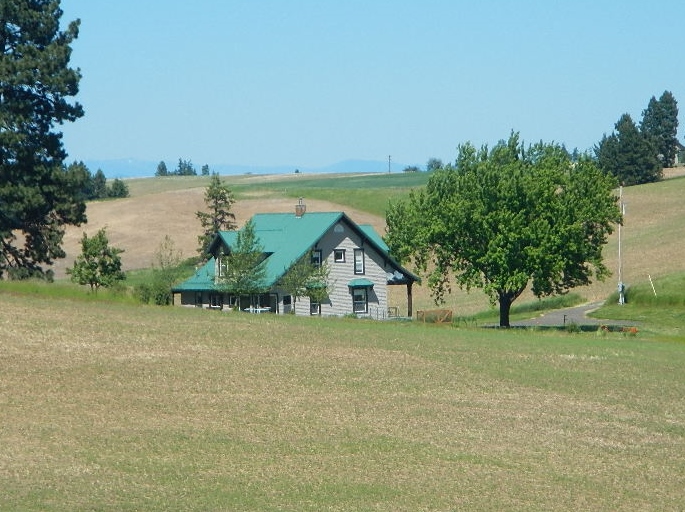
[I should always have the camera in my pocket, but it didn't happen today, so I illustrated with recent pictures showing the general topography of the area. In the last picture you can see the top of the maple tree in the yard and the chimney of the house but you have to look for them.]